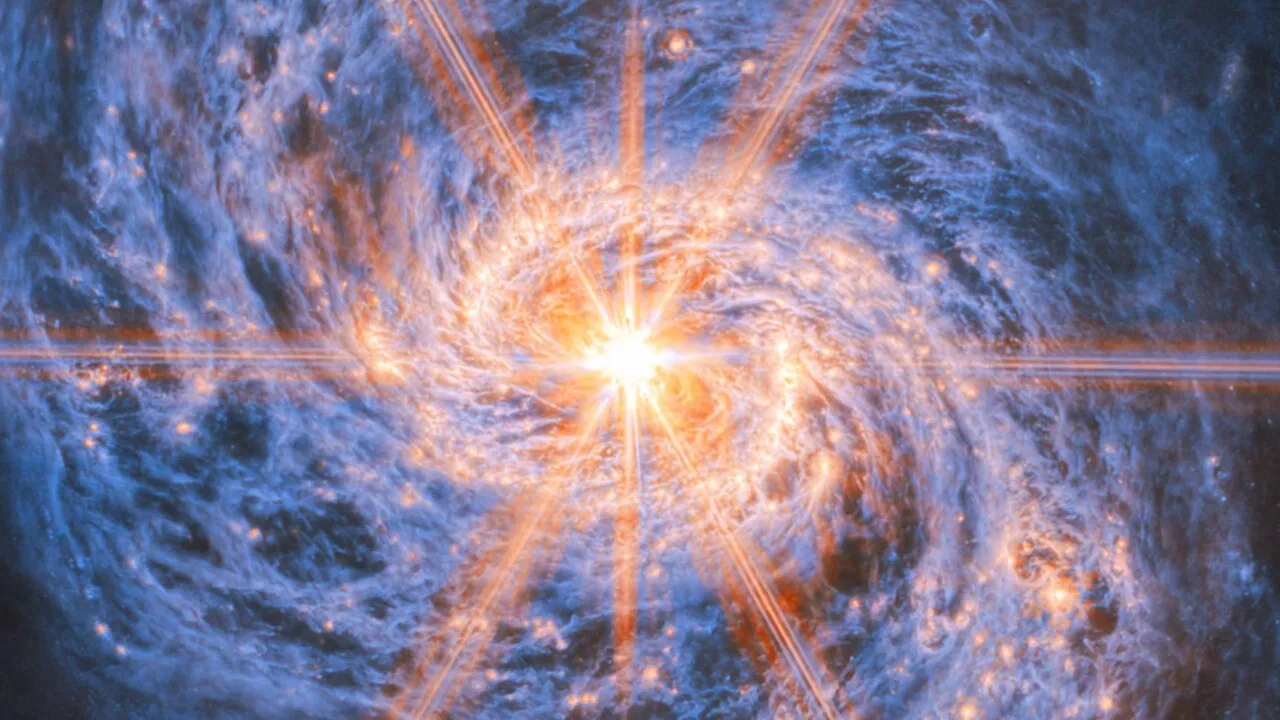
Washington: The powerful James Webb Space Telescope has delivered an extraordinary new view of the barred spiral galaxy Messier 77, revealing intricate streams of gas, dust and intense star-forming activity hidden deep within the galaxy’s glowing structure.
Located nearly 45 million light-years away in the constellation Cetus, Messier 77 — often referred to as M77 — has long fascinated astronomers. But Webb’s ultra-sensitive infrared instruments are now exposing the galaxy with remarkable clarity, allowing scientists to peer through cosmic dust clouds that previously obscured its inner workings.

At the heart of the galaxy lies a supermassive black hole estimated to contain nearly eight million times the mass of the Sun. This gigantic object is actively consuming surrounding gas and dust through a blazing accretion disk, creating what astronomers call an active galactic nucleus. The intense energy generated near the black hole shines so brightly that it overwhelms much of the surrounding starlight.
One of the image’s most striking features is the dramatic six-pointed diffraction spike radiating from the galaxy’s centre. This signature effect is created by Webb’s unique hexagonal mirror design and internal support structure. While diffraction spikes are commonly seen around bright stars, the nucleus of M77 is luminous enough to produce the same dazzling effect.

Webb’s observations also highlight the galaxy’s distinctive bar-shaped structure, believed to channel gas and dust inward toward the hungry black hole. Encircling the central bar is a brilliant starburst ring stretching nearly 6,000 light-years across. Within this glowing ring, vast stellar nurseries are rapidly forming new stars, appearing as fiery orange pockets scattered throughout the galaxy.
Astronomers explain that the spiral arms of M77 are not rigid structures but density waves where stars and interstellar matter continuously move in and out. The new infrared imagery helps researchers better understand how galaxies evolve, how black holes influence their surroundings and how star formation unfolds on colossal cosmic scales.
The latest observations from the James Webb Space Telescope once again demonstrate the observatory’s ability to uncover hidden details of the universe, offering humanity one of its clearest looks yet at the dynamic anatomy of a distant galaxy.